

The last app builder you'll ever need. Instant by default.
Vorx is an AI app builder whose apps are instant, offline-capable, and realtime by default — powered by our own sync engine, VorxSync.
A first look
This isn’t a mockup
Every Vorx build is a real running app — its own database, auth, and live URL, instant and multiplayer from the very first prompt.
The product is built and working today — every screen below is running software, not a mockup or a roadmap. We're putting the finishing touches to it before we open the doors.
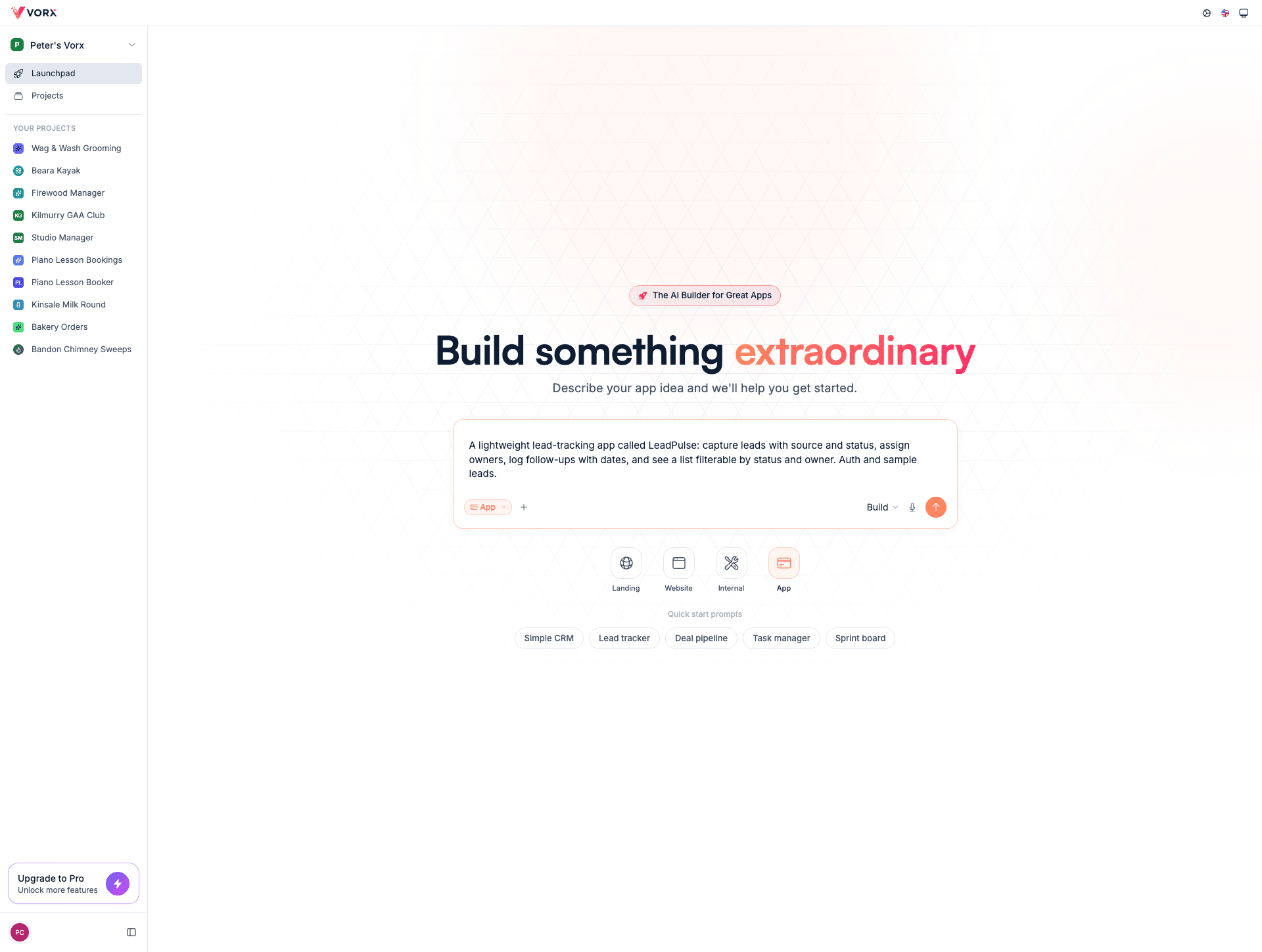
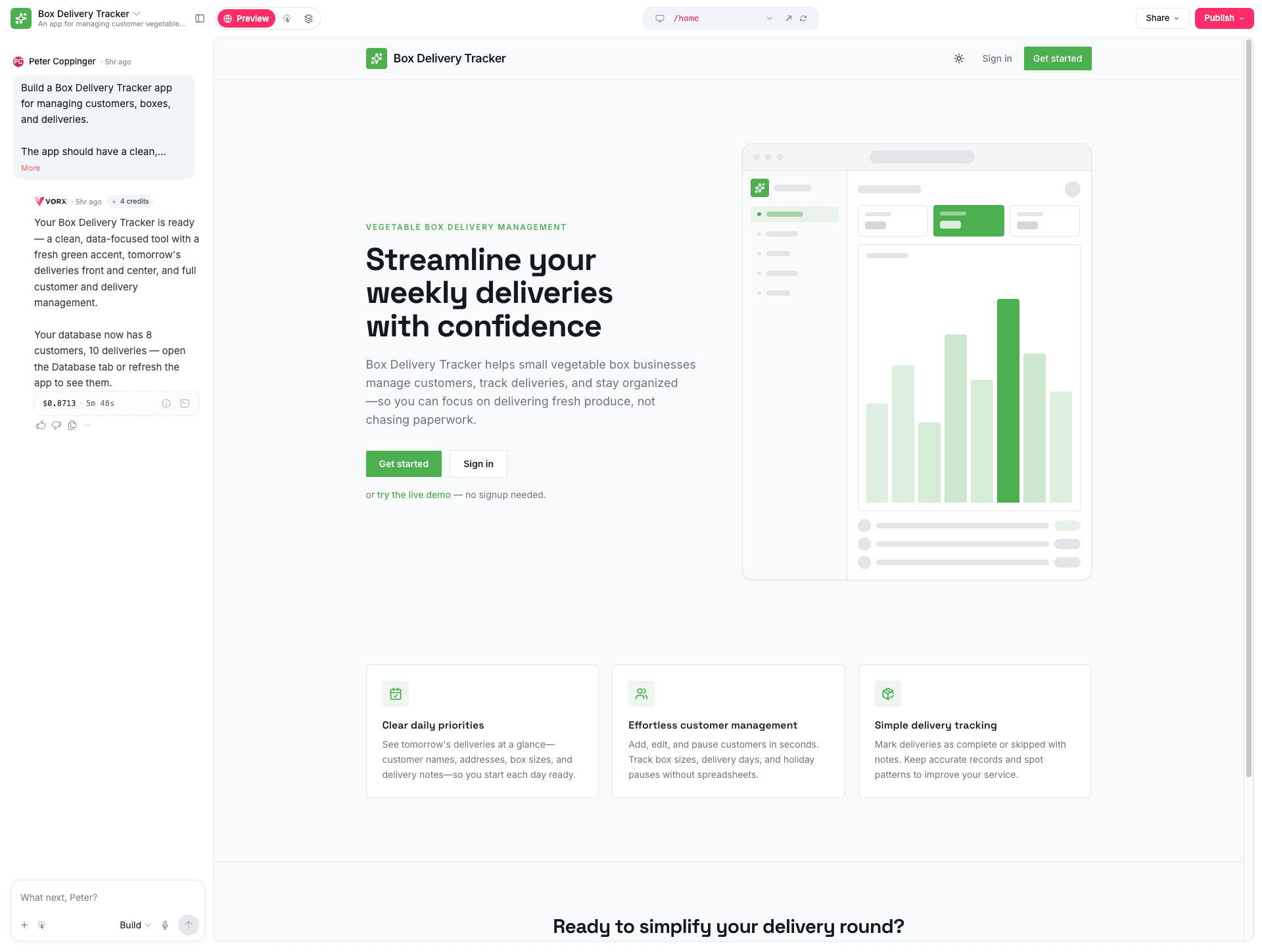
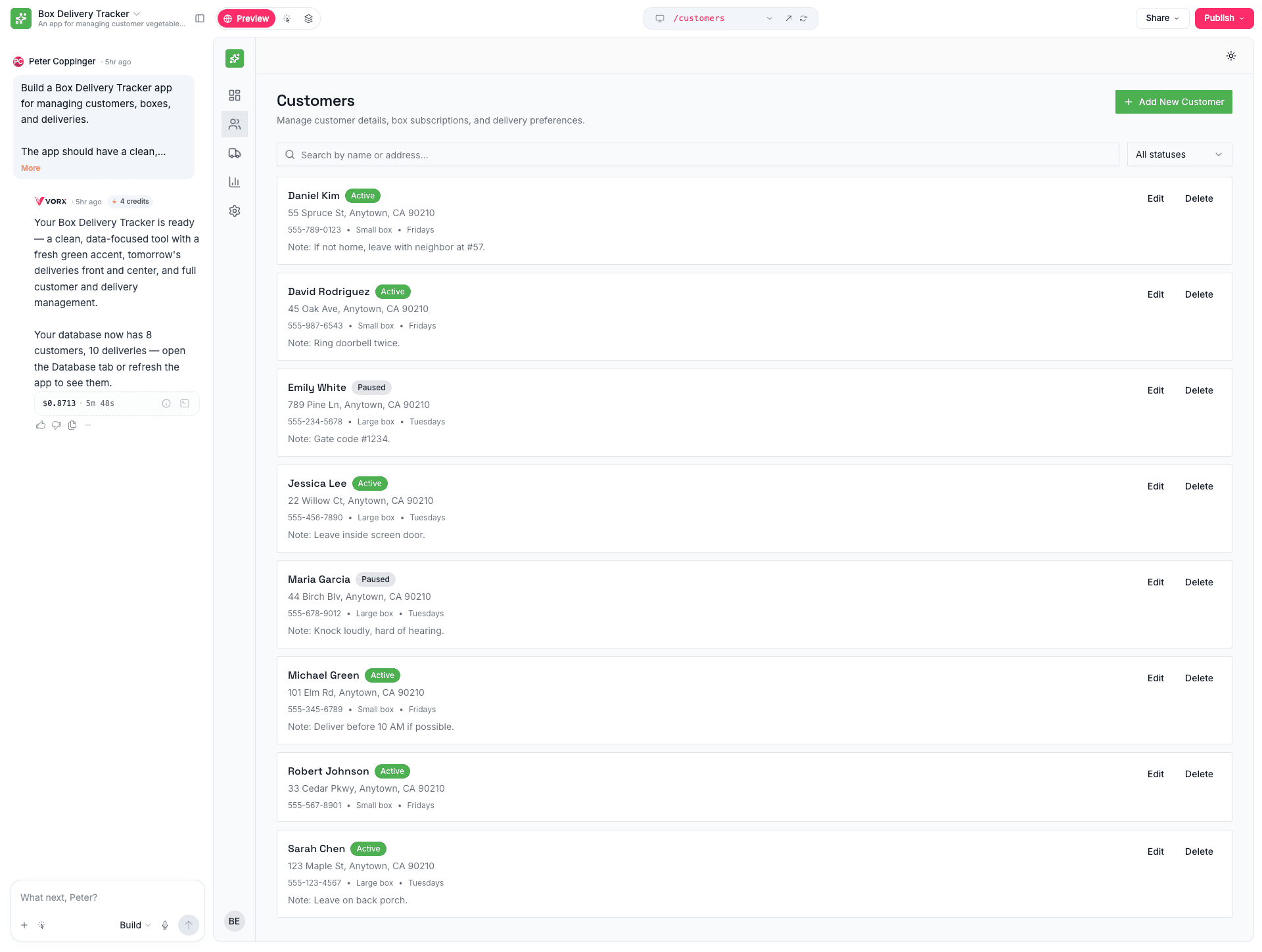
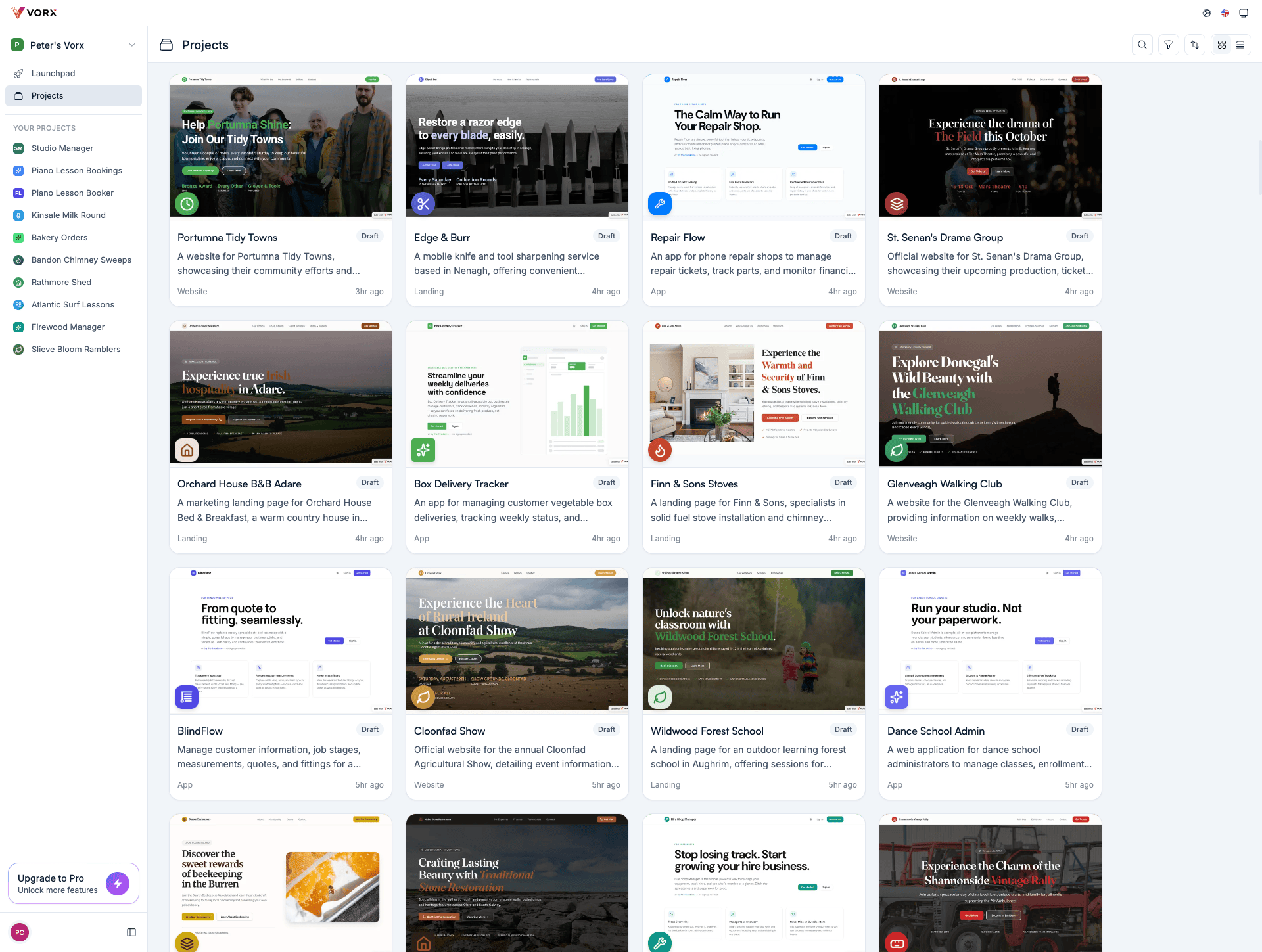
It starts with a sentence. Describe the app you want — or take a quick-start prompt — and Vorx runs with it.
The opportunity
One of the fastest-growing markets in software history — and still wide open.
$4.7B
vibe-coding market
~38% CAGR — growing roughly 2× the broader no-code category
$22.2B
AI code tools by 2030
projected size of the AI-assisted software-creation market
$500M+
ARR in under 2 years
category leaders racing past it — Lovable ~$500M, and Replit on record guiding to $1B this year
$6.6B–$9B
valuations, already
multi-billion-dollar rounds in a category barely two years old
The market is enormous and compounding — yet no one has won on the thing that matters most: the quality and feel of the app that actually gets built.
Category figures, mid-2026 — directional and about the market, not Vorx.
Use Cases
- Apps Core focus — Full-stack web apps with login and data
- Websites — A whole site, not just a landing page
- Internal Tools — The tool eng has not got to yet
- Prototyping — A clickable proof of concept in hours
By Team
- Founders — Ship before you pitch
- Product Managers — Prototype, don’t spec
- Designers — You are the handoff
- Marketers — Launch pages in minutes
- Sales — Build the prospect’s use case on the call
- Ops — Get the process out of the spreadsheet
- People — HR tools that match your actual policy
11 segments we already build for — one product, that many ways in. Apps is the one we are pointed at, and the rest come along for free.
Why now
The wedge is hiding in plain sight.
The app itself is the weak spot
Every competitor generates apps that have no offline support, no realtime, and laggy interactions. The thing users actually touch is where everyone is weakest. Nobody using an app cares which tool generated it — they judge the app in front of them, and that judgement is the whole game.
Models are commoditized
The frontier models are a shared utility everyone rents. The moat isn’t the AI — it’s the runtime and the quality of the app it produces.
The backend is rented
Rivals run on third-party infrastructure with third-party margins. Lovable had to buy a cloud provider to fix it. We own our backend from day one.
“At the end of the day, all customers care about is THEIR app. That’s how we win.”
The Vorx edge — VorxSync
Every app ships instant, offline, and realtime — by default.
0ms-feel interactions
Optimistic, local-first updates. Every tap lands instantly — no spinner, no server round-trip.
Works offline
Apps keep working with zero connectivity and reconcile automatically the moment they’re back online.
Realtime multiplayer
Live collaboration, presence, and shared state are built in — not a feature you bolt on later.
A backend we own
Our infrastructure, our margin, our lock-in. The platform compounds with every app shipped on it.
VorxSync isn't a research project — it's proven tech that already powers Success.co in production.
You see the price before you spend it.
Every other builder spends your credits first and tells you the price afterwards. We think that is backwards. The number one complaint about all of them is that you cannot predict the cost, so that is the part we fixed first.
What you're charged for
- Changes that build and pass their checks
- A price you saw before the change ran
- Never more than the limit you approved
What's free
- A build that breaks
- A change that fails its checks
- A run that changed nothing
Instant, offline and realtime — running live, in your browser.
The plan
The strategy
The biggest opportunity in the world
Software is the largest industry there is, and the ability to make it has just been handed to everyone. Every business that ever wanted an application and could never justify the cost of building one is now reachable. This is not a fight over a slice of the developer-tools market — it is a run at the work itself.
A unique edge in VorxSync
Anyone can call the same models we do; that part is a commodity and we expect it to stay one. What nobody else can do is generate an app straight onto a local-first sync engine they own outright. VorxSync is years of work, already proven in production, and it is the piece of the stack no model vendor can hand our competitors.
Focused exclusively on apps
We intend to be the best app builder in the world.
The others are trying to be everything at once — sites, pages, tools, apps. We would rather be the best in the world at one of them. Apps are also where the credits go: a landing page is one build and done, while a real application is built over weeks and then extended for months. Winning apps means winning the most valuable and most repeated work in the category.
Taste is the multiplier. At every turn we are making the design and the experience for the end user genuinely stunning — the spacing, the motion, the empty states, what happens the moment someone clicks. That comes from years of building products people actually use, and it is the hardest thing here for a competitor to copy, because it is not a feature anyone can add to a backlog.
A business, not an app
Getting the app working is where every other builder stops, but our customers are not trying to own an app — they are trying to run a business. So we keep going: setting their Stripe products and prices up, wiring forms so enquiries land somewhere useful, domains, auth, roles and permissions, publishing. At each juncture we do the next thing for them instead of handing over a to-do list. That is what turns a build into a business, and a one-off user into a subscription.
A strong brand
A four-letter .com is close to unobtainable today — they were all claimed years ago and the ones that move change hands for serious money. We hold vorx.com outright, and it is short, sharp and easy to say in any language. That hands us something most startups never get: a name people can repeat. The goal is for Vorx to become a verb — "just Vorx it" — the way one or two products in every generation manage. A name that spreads by word of mouth is the cheapest distribution there is.
Where we stand
What we're shipping
How Vorx compares to the three builders we rate — and what's still to come.
| Feature | Vorx | Lovable | Base44 | Replit |
|---|---|---|---|---|
| Instant, local-first writes (no spinners) | Yes | No | No | No |
| Apps keep working offline | Yes | No | No | No |
| Realtime and multiplayer by default | Yes | No | No | No |
| Form capture | Yes | No | No | No |
| Real backend included (auth, database, hosting) | Yes | Yes | Yes | Yes |
| Build by chat, with live preview | Yes | Yes | Yes | Yes |
| Custom domains | Yes | Yes | Yes | Yes |
| Team workspaces | Yes | Yes | Not confirmed | Yes |
| Version history & rollback | Yes | Yes | Yes | Yes |
| Export your code — no lock-in | Yes | Yes | Yes | Yes |
Vorx's column is our own. Competitor capabilities are as we understand them at the time of writing — a dash means we haven't confirmed it either way.
The team
A founder who has built and scaled this before.

Peter Coppinger
Founder & CEO
Serial founder and engineer from Cork. Co-founder, former CEO and lead developer of Teamwork.com, used by hundreds of thousands of companies. Entrepreneur of the Year Ireland 2018. Founder of Success.co, where VorxSync was proven in production.
The vision
Vorx becomes the serious way millions of people and companies build something extraordinary.
Its own database, logins and address.
The raise
We're raising our seed round — now.
A proven founding team. An owned sync-engine moat. Attacking the fastest-growing market in software. We're looking for partners who move fast and think big.
- Build the team to ship at the pace this market demands.
- Ship the product — the AI builder and VorxSync, together as one runtime.
- Win the serious-builder beachhead — the people who need running software, not a mockup.
FAQ
Questions we get asked
Yes — absolutely. Get in touch at investment@vorx.com and we will walk you through the real product, building a real app, live.
It is a fully working product, not a prototype: every screen on this page is running software. Today you can describe an app in plain English and get a real one back — Build and Plan modes for chat-driven work, a live preview while it builds, and a real backend included with every app in auth, database and hosting. Every build ships on VorxSync, so writes land instantly, collaboration is realtime, and the app keeps working offline and reconciles when it reconnects. You can publish to a live vorx.live URL or your own custom domain, invite unlimited collaborators with roles and permissions, and export a clean repo whenever you want — there is no lock-in.
Landing pages, marketing websites, internal tools, full SaaS applications — in practice, anything you can describe. That said, our strategy is deliberately focused on web apps, because we believe that is where the biggest opportunity is. An app with real data, real users and real collaboration is the hardest thing to build well, and it is exactly where being instant, offline-ready and realtime is worth the most. The simpler end we handle comfortably; the hard end is where we win.
Yes. Our status page at status.vorx.com was built with Vorx, and so is the website you are reading this on. We use it for our own work — the fastest way to judge a builder is to look at what its makers ship with it.
status.vorx.com →We count about ten serious AI app builders, and in our opinion only three of them are any good: Lovable, Base44 and Replit. What those three have done is the argument for this category, not against it. Lovable and Replit are both past $500M in ARR in under two years, Replit is on record saying it expects to do $1B this year, and the category is already writing multi-billion-dollar rounds. Base44 bootstrapped to a few million in ARR in about six months and was acquired by Wix. That is a market forming at extraordinary speed, and it is still early. Our builder is at their level — and VorxSync puts us ahead at the edge that actually matters, because what we generate is instant, offline-ready and realtime rather than another online-only demo. We think that is a huge opportunity.
Nothing stops them trying, but a sync engine is not a feature you add in a sprint. Conflict resolution, ordering, partial replication, offline queues and schema migration across devices that have all been offline for different lengths of time is the kind of engineering that eats teams alive. VorxSync has been written and hardened in production at Success.co over years, with real customers who would be furious if it lost their data. That head start is the moat.
Vorx does, outright. VorxSync was written by Peter Coppinger and is 100% privately owned by the company — no third-party licence, no open-source dependency at the core of it, and nothing owed to anyone else for the part that makes our apps different.
We assume they will commoditise — the model is an input we buy, and our competitors buy the same one. What no model hands you is the runtime the generated app sits on. That is where VorxSync lives, and it is the part that decides whether what you get back is a product or a prototype.
The seed round is €2m for 10% of the company. We would expect the investors who come in now to want to participate in later rounds as well.
Two things. First, building the initial team. Second, funding free builds: a demo or test build costs us roughly a dollar in model spend up front, and that is true for everyone in this category. We expect somewhere between one in twenty and one in thirty of those to convert into paying customers, which is in line with what others in the space see — and at that ratio it is a remarkably cheap acquisition channel.
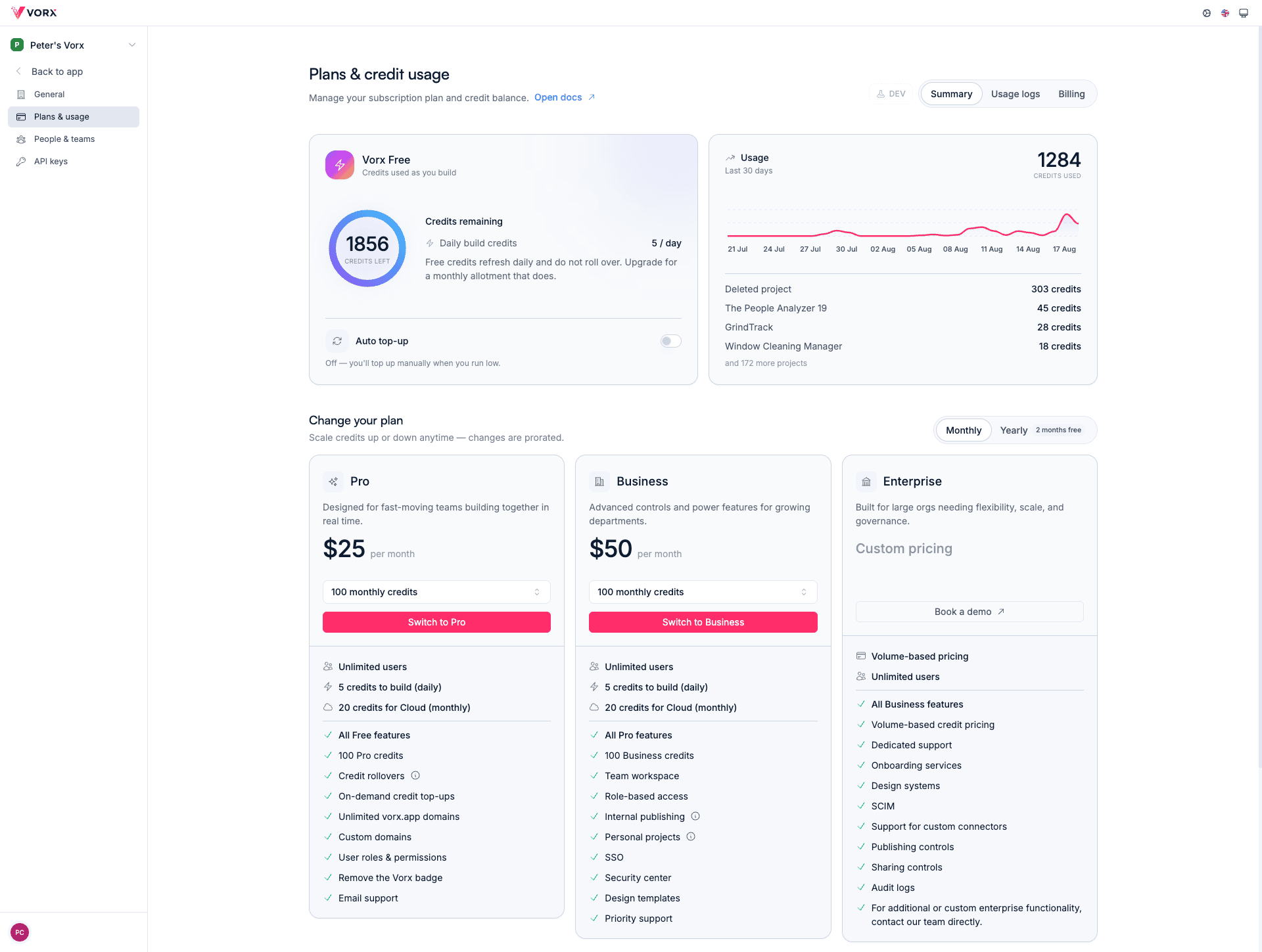
Subscription tiers with build credits: a free plan, Pro at $25 a month and Business at $50 a month, and Enterprise on volume pricing. Credits meter the expensive part — generation — so revenue scales with how much people actually build. The economics in this category are unusually good. The builders making real revenue are taking a margin of up to 50% on top of the model calls they resell, and those margins may well widen as the model providers compete each other down on price. We have no loyalty to any one model: we will route to whatever gives our customers the best experience, and that freedom is exactly what protects the margin.
Get in touch at investment@vorx.com and we will answer them properly. One ask: serious enquiries only. We are heads-down building and we do not have the time for tyre-kickers, so if you are genuinely interested we will make plenty of time for you.