

Building in Public #14: It Felt Like a Slow Week. But Stats Show Otherwise.

By Peter Coppinger
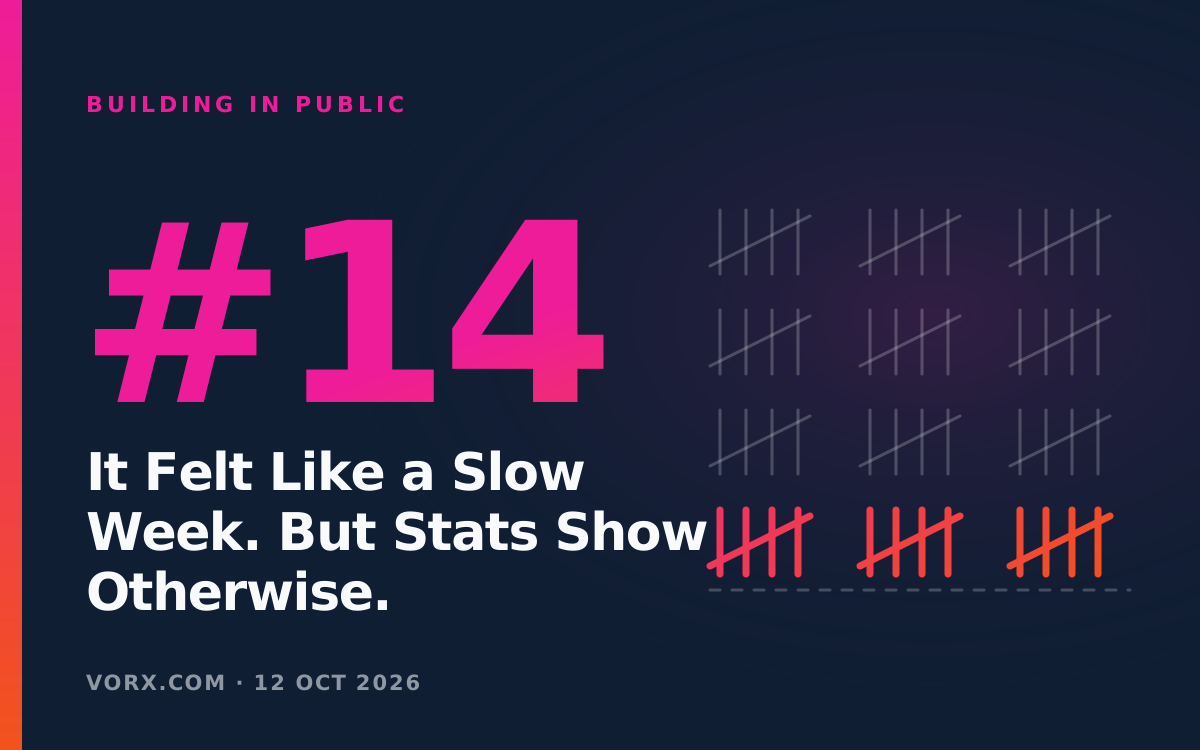
OK, I'll be honest. This felt like a slow week. No big launch, no new feature I could hold up and say "look at this!" On Tuesday I even ran out of Claude Code usage and spent the rest of the day in Cursor, polishing the UI. I actually enjoyed that.
The frustrating thing is how long it's taking to get speed and quality into the build and update engine. My bar is beating the best AI builders in the world. I guess if it was easy anybody could do it.
Then I counted what actually went live. 613 pull requests reached production between 5 and 11 October.
The week in numbers · 5–11 October
Pull requests merged to main, by repository.
Builder
the build and update engine
App
the editor you use
Service API
accounts and billing
Website
this site
Small changes, most of them invisible to a customer.
Most of those you'll never notice, and that's kind of the point. A project logo that used to sit there as an empty box now stays hidden until your project has a name, then fades in. Your first publish gets a bit of confetti. Form submissions and deleted projects have a proper Trash you can restore from. Dialogs on a phone use the whole screen. The free plan now gives you 5 credits a day, up to 30 a month. It's the polish a customer only notices when it's missing.
Launching Workforce at RebelCon
On Tuesday I met a friend (hi Chris!) for coffee and showed him the project. He said, "Let me get this right. You built ALL of this, taking on the Goliaths solo, in 3 months, and you're disappointed it's not moving faster?!"
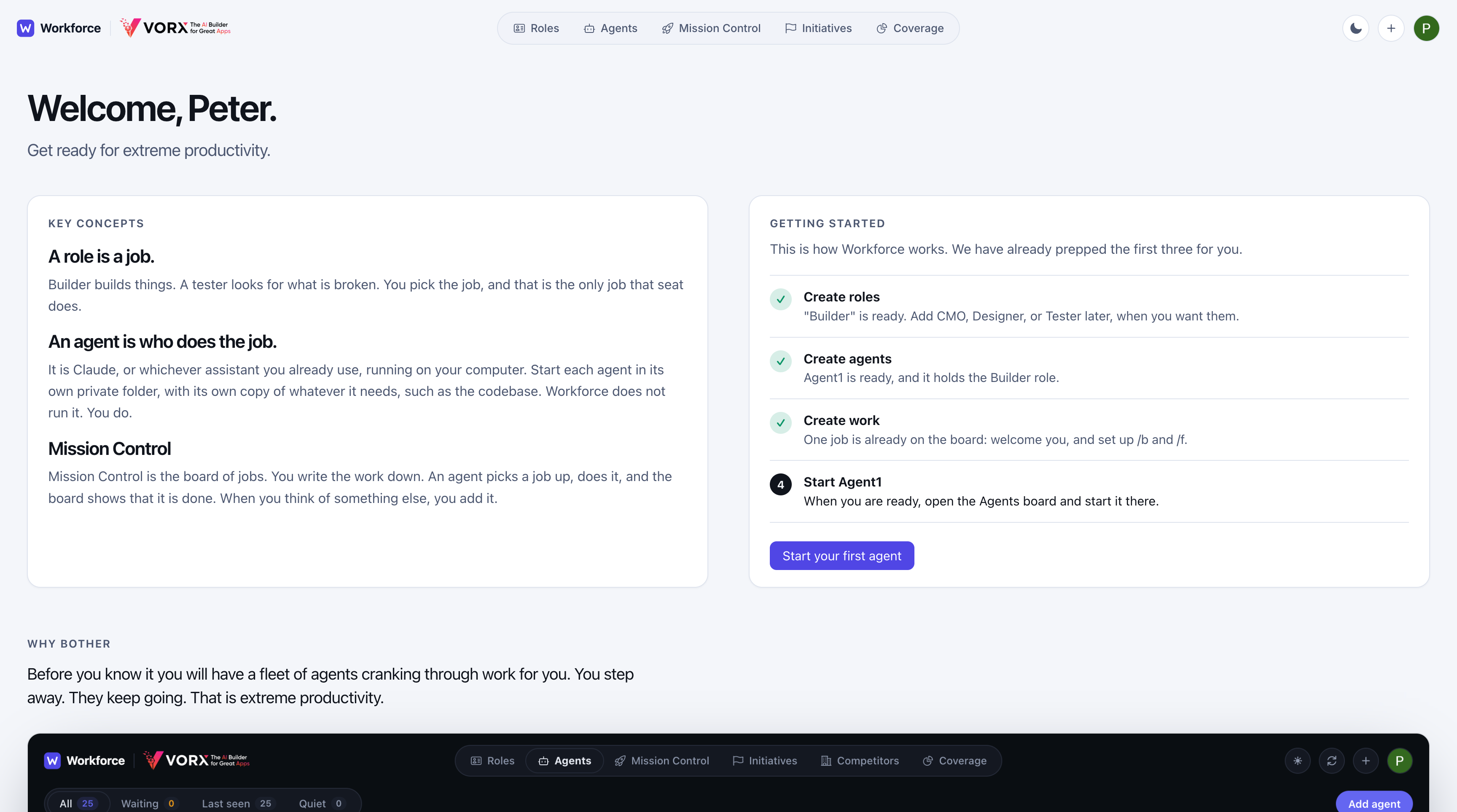
Later that evening Chris gave me some feedback: Workforce is daunting to get going with. So I overhauled its onboarding. New accounts now start with a default role, an agent and a first mission, and there's a welcome screen that explains the concepts.
Chris had also asked if I was going to RebelCon, a tech conference here in Cork. I didn't even know it was on, because I've had my head down. I ended up not only going but speaking at it, as a last-minute addition. I literally made my slides with Claude while sitting at the conference, two hours before my talk, on dodgy wifi.
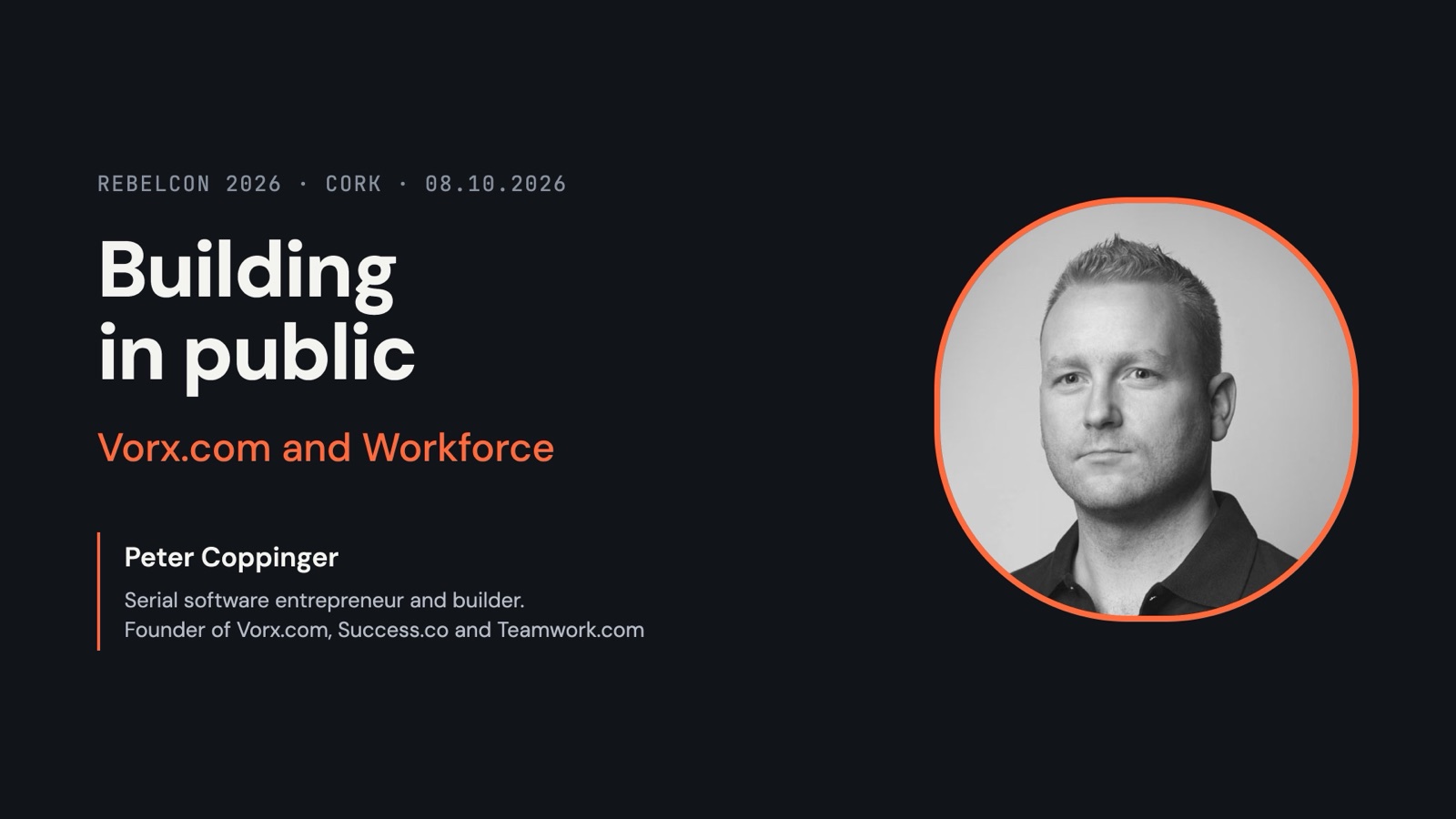
In my talk I launched Workforce. I've had a good few sign-ups since, so hopefully people enjoy using it. I probably need to promote it more.
It was interesting that Lovable was mentioned twice and Replit three times before my talk, and when I asked the room, half of them had heard of those products. I got a round of applause for my ambition when I said I'm taking on the biggest new category of software, solo, from Cork. Thanks to the crew at RebelCon for squeezing me in!
I should have been in the detail
On Saturday night I finally worked out why everything felt so slow, and I didn't love the answer. I should have been in the detail more and not just trusting the process.
I hadn't realised the AI was still updating the old engines with every round of work. We had six build paths, so every fix was being made and tested more than once. And the path from development to release had picked up layer after layer of reviews, tests and waits, each one sensible on its own and slow together.
Why it was slow
1The old engines were still being updated
Six build paths, so every fix was made and tested more than once.
2Too many layers between development and release
The pink steps are waits. A full day could hold two or three hours of real work.
So we changed how we work, and we're not spending a cent more to do it:
- One engine. The old ones get switched off and deleted.
- Cheaper tests first. Free checks, then a quick 3-build test on every engine change, aiming for an answer in under 30 minutes.
- Automatic deploys to production, once tests pass. Several times a day, and a release that fails its checks afterwards rolls back on its own.
The new way
How a change reaches customers: before this week, and from now on.
Before
- Six engine paths
- A test per step
- A nightly hand-built release
- Exceptions coming to me
After
- One engine
- Cheap checks first
- A 3-test quick check on every engine change, targeting an answer in under 30 minutes
- Automatic deploys to production once tests pass, with automatic rollback
Engine 004, one week on
Last week I called 004 the new hope. It was one day old. Its first full week on the job board test:
Engine 004, zoomed in · 6–11 October
The job board test from #13: a quality score out of 10 from a 10-point checklist, timed wall-clock from request to build complete. Every number here is a bench run on a local clone, not production.
Engine 004
The new hope… one week on
Latest run, today’s default
9 / 10 in 2 min 58 s on 11 Oct. Missed “post a job”.
Most common misses
Not finished in time, 15 of 24 runs. “Post a job”, 13 of 24.
On production
At least 4 builds on 004, 0 fallbacks. The listing may be incomplete.
Still short: the median is over 4 minutes, and nothing was measured on production this week.
Plan engine, a separate thing: on as the default on 11 Oct, off the same day, fixes landed, not yet back on. The 10 writer-model experiment runs are left out.
The typical quality score went from 6 out of 10 to 9 out of 10, and the best run hit 10 out of 10 in just over 3 minutes. I'm really pleased with that. It's still not at my bar, though. The typical build is just over 4 minutes, and all of these are test runs on our own machines, not production.
We also flipped on a planner that sits on top of 004, and switched it off again the same day. Apps without sign-in were sending people round in circles to a login page that didn't exist. The fixes are in, and it goes back on once a test build comes through clean.
Progress on updates
I'm pretty sure we'll have initial builds on par with the best very soon. Updates are different. Every change someone asks for lands on an app that already exists, written in their own words, and it's impossible to predict every possible prompt. So updates are going to be an ongoing area of improvement forever, and I'm OK with that.
Honestly, it was a mixed week for updates, and the numbers are patchier than I'd like.
On Wednesday we were level with Lovable and one behind Base44 on the same 12 edits. By Sunday, a new test built from real customers' thumbs-downs passed just 1 of 9. That looks worse than it is: most of the misses are one bug, where the reply tells the owner about an error on their page that never happened. That fix is in progress. Replies are also running long (6 of 9 went past the length we set), and an edit asked for on every product page only reached 3 of the 4.
On the plus side, edits on a copied project were being wrongly refused, and that's fixed. And every thumbs-down a customer gives us now becomes a test we run before each change, so the same mistake can't quietly come back.
The blind taste test
Last week Lovable won both apps, and we came second on one and third on the other. Tonight I rebuilt our two apps on this week's engine and had them judged again, blind, against the same Lovable and Base44 apps from 29 September. This time it was screen by screen, on the four screens we could match fairly:
The blind taste test, round two · 11 Oct
Studio CRM · Inconclusive
Lovable
Vorx
Base44
Inconclusive this week, so using last week’s result here.
Allotment app
Lovable
Vorx↑ was 3rd
Base44
Same Lovable and Base44 apps as 29 Sep, against fresh Vorx builds on this week’s engine. One AI judge, screen by screen, each pair read in both orders (a split counts as a tie), one build per app.
Against Base44 we won 3 and lost 1, and the one we lost was a screen where our app couldn't save a project. That's a real bug, and we're fixing it. Against Lovable we tied 2 and lost 2. So we've caught Base44, and Lovable is still ahead. It's one AI judge and one build per app, and the other two haven't moved since 29 September, so I won't get carried away.
Manual testing
This week it felt like I was working for the AI instead of the other way around. Some integrations the AI just can't test itself, like Figma, Dropbox and Google, because they need a real person signing in to a real account. So I had a list of manual tests to do for my Chief of Staff. Yes, I now have a Chief of Staff (one of my AI agents) who deals with all the small things, including getting me to do work.
Loads of integration improvements came out of it:
- Google Drive and Dropbox. You can start a new app from a file in either, straight from the + menu on the launchpad. The Drive picker now browses your folders and "Shared with me", and you can switch or disconnect your Google account from the same menu.
- GitHub. Connecting now signs you in first and shows your own accounts. A personal account can create its repository with your own sign-in, or connect an existing empty one.
- Figma. A Figma frame you pick as a design reference now reaches the builder, and disconnecting asks first.
And loads of bugs found and UI polished along the way.
The boring company bits
Not everything in a startup week is product. Our business bank account was approved on Tuesday. I went with Revolut Business again. For accounts I'm using Zoho Books for now, because we don't need anything complex just yet. I've also started moving every bill over to the new company: seven services, one at a time.
We cut our cloud costs on Saturday too. The builder runs on 2 CPUs now, and 155 of our 156 Supabase databases moved to the smallest size.
None of it is exciting, but you can't launch without it.
“All coding is now just cost control.”
That’s been rattling around my head all week. AI makes code abundant. Writing it isn’t the hard part anymore, so the real skill is controlling what it costs to create value: the model calls, the test builds, the databases, the hours spent waiting. I think the future of coding is cost control.
Peter Coppinger
Note to self
I must actually put Workforce on LinkedIn and promote it more. I shut down my personal Twitter two years ago and had no regrets until recently, when, you know, it would be handy for this sort of thing. I guess I'll just go all in on LinkedIn.
So maybe it wasn't such a slow week after all. I'm sure we're on the right path. This week it's laser focus on builds and updates, and on beating Lovable and Base44 in blind tests. Back to it!
P.S. There's a potential new direction we could take the 004 engine in. We're running some lightweight tests before making any fundamental changes. More on this next week.
Stay updated: one founder, an army of AI agents, building this in public.
Get each new diary entry by email: the wins, the failures, and the one number we're chasing. No spam, unsubscribe any time.
Shipped this week 6 Oct – 12 Oct
- AI: Watch an update happen
- Platform: Your first publish gets a celebration
Comments